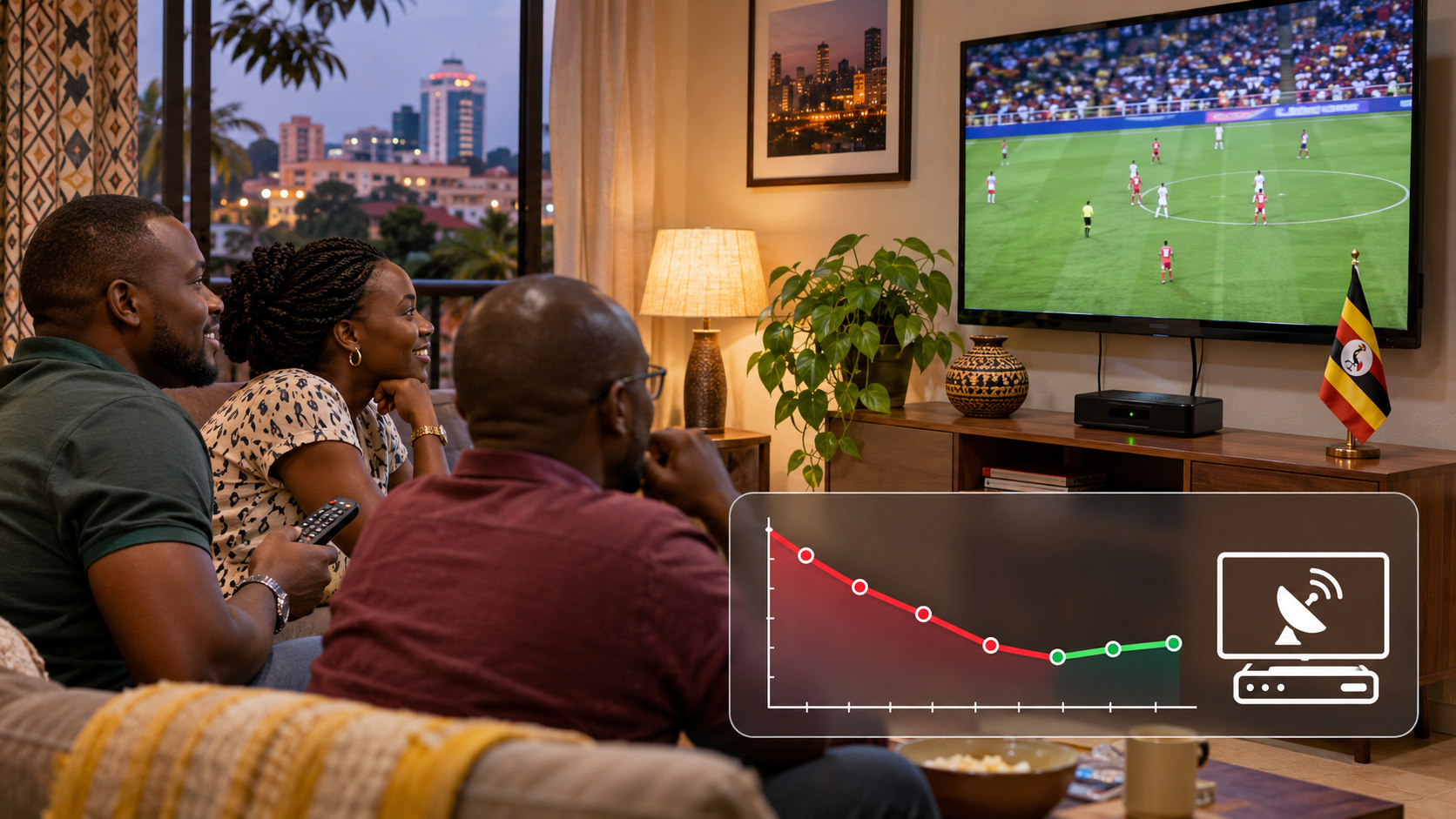
Uganda's pay-TV market has stopped shrinking, but it has not come back. Roughly one million homes pay for television in a country that will co-host AFCON 2027. Rights holders and sponsors who value Ugandan reach on pay-TV alone will undersell the tournament there; the bigger prize is the 1.6 million accounts that have gone quiet, and the audiences who never had one.
What happened
The Uganda Communications Commission's (UCC) July–September market performance report puts active pay-TV subscriptions at about one million at the end of September 2026, as reported by Broadcast Media Africa on 26 November. That holds the 200,000 subscriptions regained between March and June, when active accounts had fallen to an eight-year low of about 800,000. The base is still around 39% below the 1.65 million recorded in December 2021.
Uganda has about 2.6 million registered pay-TV accounts, so roughly 1.6 million are inactive. DStv is the largest operator, followed by StarTimes, Azam TV and Kampala SITI Cable, but UCC does not publish subscriber figures by operator.
What it means
For rights holders, pay-TV in Uganda is a small, price-sensitive base. A pay-TV exclusive buys depth with roughly one million homes, not national reach. That matters for FUFA and the Uganda Premier League as much as for CAF: a package sold only to pay-TV leaves most of the audience to free-to-air, public viewing and, too often, piracy. UCC itself described digital piracy as a national challenge when it convened stakeholders in July.
For broadcasters, the dormant accounts are the opportunity. The decoders are already in homes; the barrier is price and a reason to pay again. Canal+ is clearly chasing volume: MultiChoice launched SuperSport Swahili on 5 November for Kenya, Tanzania and Uganda as part of a DStv package refresh. AFCON 2027, which Uganda co-hosts with Kenya and Tanzania and which SuperSport will carry across sub-Saharan Africa, is the strongest reactivation hook this market will see for years.
For sponsors, the missing operator-level data is the real problem. If a sponsor cannot see who watches which channel, it cannot price Ugandan exposure with confidence, and it will default to discounting it.
What we'd do
- Rights holders: sell Uganda as a combined package. Keep pay-TV exclusivity for live matches, but carve out free-to-air highlights or a delayed free window, and write audience reporting into every contract.
- Broadcasters: build an AFCON reactivation offer aimed at the dormant accounts: short-term passes timed to the qualifiers and the finals, priced for the household that lapsed rather than the one that stayed.
- Sponsors: plan Ugandan AFCON activation around where people actually watch: fan zones, public viewing and mobile-first content. Ask your broadcast partner for measured Ugandan audiences, not registered subscriber counts, before you sign.
- The industry: press UCC and operators to publish audience and subscriber data by operator. Transparent numbers raise what Ugandan rights are worth; opacity lowers it.
Sources: Broadcast Media Africa, "Uganda Pay-TV Market Stabilises At One Million Subscribers – Report", 26 November 2026 (citing UCC's July–September 2026 market performance report); Uganda Communications Commission, "UCC rallies stakeholders to combat digital piracy", 13 July 2026; DStv Kenya, "The New DStv Era", 26 October 2026; ThisDay, "CANAL+ Secures AFCON 2027 Qualifiers, Finals Broadcast Rights", 29 September 2026.