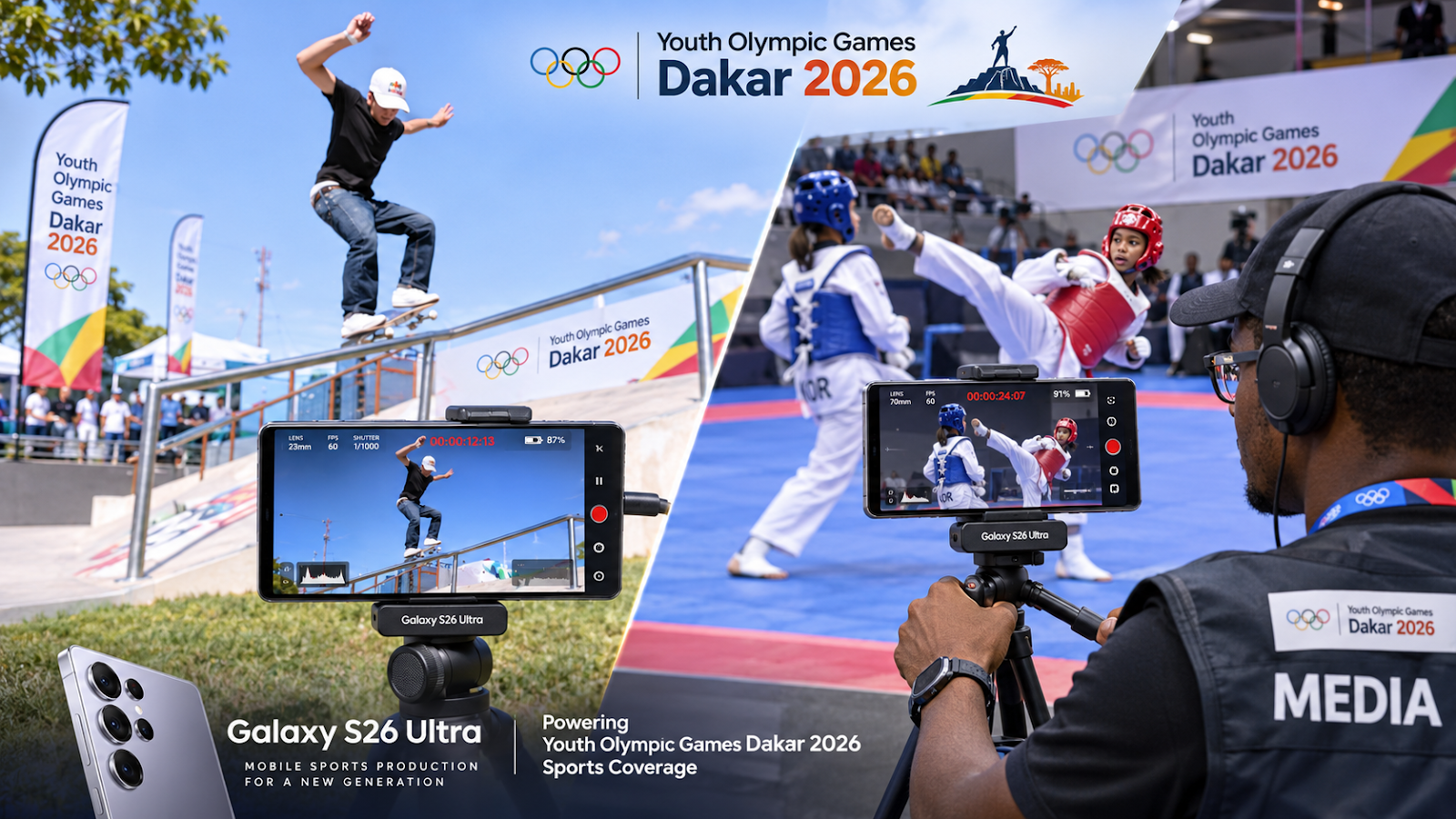
Samsung's decision to put smartphones into Olympic coverage at Dakar 2026 is being presented as a brand activation. We think it is more useful than that. It is a public test, on African soil, of a hybrid production model that African leagues, federations and broadcasters could afford to run every week, not just during a Games. The question for rights holders is no longer whether phone-shot footage is good enough. It is how to build it properly into their production and rights plans.
What happened
On 2 November, Samsung said Galaxy S26 Ultra phones are being used in skateboarding and taekwondo coverage at the Youth Olympic Games Dakar 2026, working alongside existing broadcast cameras to add handheld, close-up and vertical shots. Samsung described the phones as complementing traditional production rather than replacing it, and said Dakar is a chance to test how mobile technology can support future Games, including LA28. It is also debuting its Victory Selfie at medal ceremonies, using Galaxy Z Flip7 phones.
The setting matters. Dakar 2026, running from 31 October to 13 November, is the first Olympic event held in Africa. The IOC expects about 507 hours of broadcast coverage, distributed by 19 media rights-holders and more than 70 sublicensees. MMS covers around 40 sub-Saharan countries, RTS is the Senegalese broadcaster, and Olympics.com is streaming live in English and French without geographic restriction.
What it means
Production cost, not appetite, is the bottleneck. Many African domestic competitions are under-produced, or not produced at all, because a conventional outside-broadcast operation is out of reach for the rights holder. A camera plan that keeps a small core of broadcast cameras and adds phones for close-up and handheld angles lowers the cost of every extra angle. The Olympic movement has now used that approach in live competition, which makes it easier for African producers to sell to cautious federations and broadcasters.
Vertical is now a broadcast deliverable. Samsung explicitly lists vertical perspectives as part of the coverage. For audiences that increasingly watch on mobile, a native vertical feed can be worth more than another wide shot, and it is the inventory sponsors want for social channels.
The rights question moves. Once phones are part of the production, footage can be captured by more people, from more positions, including athletes and officials. Rights holders whose contracts and accreditation terms do not say who may film, from where, and who owns the clips will either leave value on the table or end up in disputes with broadcasters who paid for exclusivity.
The hard part is not the camera. Getting phone footage into a live programme reliably needs connectivity, synchronisation, colour matching and trained operators. Those are the skills African production crews and facilities need to build if hybrid production is to become routine rather than a showcase.
What we'd do
- Federations and leagues: pilot a hybrid camera plan on one fixture or event this season: a minimal broadcast core, phone-shot angles and a dedicated vertical feed. Measure output, cost and audience against your current coverage before scaling.
- Rights holders: update media rights and accreditation terms ahead of the AFCON 2027 cycle so they cover mobile and creator capture: who may film, which feeds are exclusive, and who owns and can monetise the clips.
- Broadcasters: treat vertical as a separate deliverable with its own production plan and sponsor inventory, rather than cropping the main feed after the fact.
- Sponsors: handset and telecoms brands should look at production partnerships with African leagues, where their technology does visible work on screen rather than simply carrying a logo.
Sources: Samsung Global Newsroom, 2 November 2026; Youth Sports Business Report, 2 November 2026; IOC, 28 October 2026; Broadcast Media Africa, 23 October 2026.